Larimar: Properties, Facts and Photos
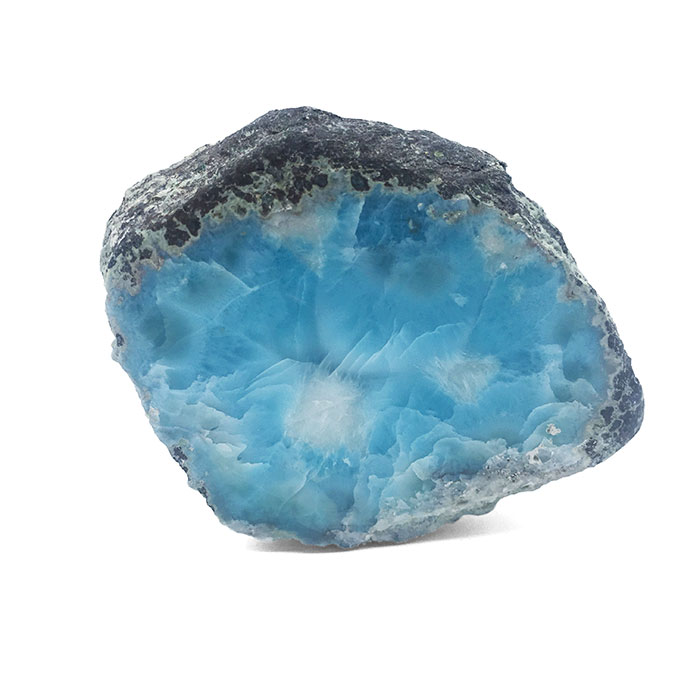
What is Larimar?
Larimar is a trade name for a variety of the mineral pectolite. Its habit is massive, meaning its crystals are tightly intergrown with no external visible shape or form. Minerals that form in this way occur as one large, shapeless mass.
The Las Filipinas mine, where larimar is found, is in the Barahona Province in the southwest of the country. It's a remote mountainous region surrounded by a subtropical forest.
Larimar exhibits a unique and intricate structure. Its primary component is blue pectolite, but it also contains other minerals such as calcite, natrolite, prehnite, clay, silicon dioxide minerals and phosphates (apatite).
Some geologists have described larimar as pectolite rock due to its complex mineral properties. Others claim it would be more accurate to classify it as a polymineral because its formation doesn't follow the conventional process normally used to define a typical rock.
Larimar is often described as the 'gem of the Caribbean'. This is not only because of where it's found but also because its colour and markings resemble the Caribbean Sea.
A spiritual master once claimed the islands in the Caribbean were part of the lost continent of Atlantis. He said one day, they would produce a blue stone with the power to heal. In the belief that this was a reference to larimar, the name Atlantis Stone started being used.
The first official record of larimar was made by the parish priest of Barahona in 1916. He requested permission to excavate the land, but permission was denied. There was no further mention of larimar until 1974.
After hearing that local fishermen had been finding beautiful blue stones on the beach, a local artisan went to investigate. He was accompanied by an American Peace Corps volunteer who was also a geologist.
The mine was found approximately ten kilometres up in the rugged mountains that line the coast. Stones were being carried down to the beach in a river that emptied into the sea.
The stone was initially named 'travelina' but was later changed to 'larimar'. This was a combination of 'Larissa', the artisan's daughter, and the Spanish word 'mar', meaning 'sea'.
The colour of larimar has shown to be stable, which means it doesn't fade when exposed to sunlight. Tests have concluded that it's not being enhanced before being cut and polished.


Safety Concerns in Las Filipinas
The only place in the world where larimar can be found is the Las Filipinas mine. In the early days, it was extracted with basic equipment such as shovels and pickaxes. It was then winched up steep vertical shafts to the surface. There was little planning and minimal ventilation and drainage.
This method of mining continued until quite recently. In the last twenty years, there have been at least eighteen fatalities, with two happening within weeks of each other. The Dominican authorities then finally intervened.
Improvements to the Las Filipinas mine have been made and are ongoing. They include upgrading drainage systems and ventilation and constructing a new 1000-metre tunnel to the heart of the mine. The tunnel also includes an escape route for use in an emergency.
The mine was closed for several years while work was being carried out. It's difficult to know for certain whether it's currently open or still closed.
Article Pictures
The photo at the top of our article is courtesy of Mike Santon. The larimar cabochon is from our collection.
Pop-up photos
Calcite: Courtesy of Stan Celestian. Natrolite: Courtesy of Ron Wolf.
The photos in our article and the links for the pop-up photos link to the original image on Flickr. You may only be able to view them if you join. Joining Flickr is free, with no additional charges.