Aventurine: Properties, Facts and Photos

What is Aventurine?
Aventurine is a quartz-rich material containing minute inclusions of other minerals that produce a subtle sparkle or spangled effect known as aventurescence.
The inclusions are often described as 'platy' in reference to their plate-like shape, and usually have a flaky appearance.
They're typically mica minerals, particularly fuchsite (fook-site), with hematite or goethite (ger-tite) producing other colours. When densely packed, the inclusions scatter light, which is why many aventurine stones appear opaque rather than translucent.
Although aventurine is often described as a mineral, it's not always correct. Some aventurine is quartzite, which is a metamorphic rock that began as sandstone. Other stones are composed almost entirely of massive quartz, meaning the crystals grew as one tightly intergrown mass.
Both types of aventurine can exhibit the optical effect known as aventurescence, a metallic-like shimmer or sparkle.
This is why some stones are labelled as aventurine quartz (composed almost entirely of massive quartz), while others are labelled simply as aventurine. Although closely related, they're not the same.
These two materials are defined by their structure, so aventurine quartz is not an alternative name for aventurine, even though the term 'aventurine' is often used for both.
The term 'aventurine' describes the stone's appearance, showing aventurescence, not its structure. Aventurine occurs in several colours. Inclusions of fuchsite cause aventurine to become green. Hematite, goethite, and lepidolite mica produce shades of pink, purple, orange, red, and brown.
The colour of blue aventurine is believed to come from dumortierite and/or copper. Shades of grey and some shades of yellow come from muscovite or ilmenite.
Aventurine is thought to have been named after a man-made material called goldstone. Like aventurine, goldstone exhibits aventurescence.
Impurities in a rock or mineral can influence its colour. The intensity or extent of the colour change can vary depending on the concentration of the impurity.
The more common orange-brown goldstone is produced using colourless glass. The stone's colour comes from inclusions of crystallised copper.
Most of the world's blue and green aventurine comes from India. Off-white, grey and yellowish-orange stones can be found in Chile, Spain and Russia. Aventurine in other colours is found in Brazil, Austria and Tanzania.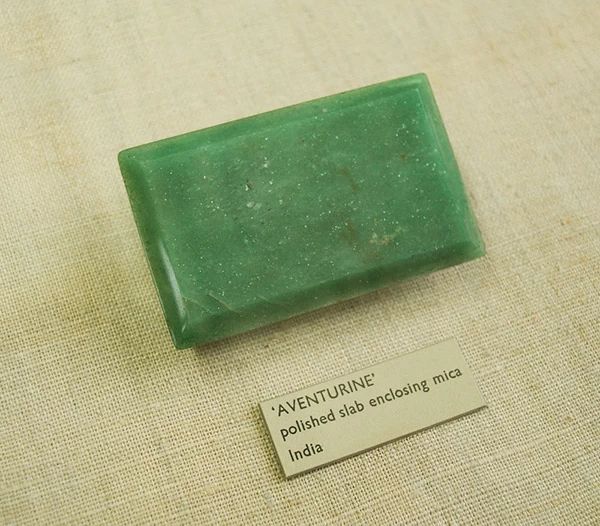


During the Stone Age, primitive tools were made of quartzite when flint was not available. Although not as easy to work with, quartzite is hard yet brittle, which makes it relatively easy to shape.
Many articles online report that aventurine was discovered by J.D. Dan in 1837; however, I can find nothing factual to support that.
J.D. Dan is likely to be James Dwight Dana [1813 - 1895], an American geologist, mineralogist, volcanologist, and zoologist. Although he wrote about aventurine and sunstone, correctly known as aventurine feldspar, there is no evidence to suggest that he discovered either mineral.

Article Pictures
The rough green aventurine in the photo at the top of our article and the orange aventurine tumbled stones are from our collection.
The second green aventurine is on display in London's Natural History Museum. Photo: Stone Mania.
Pop-up photos
The goldstone and sunstone are from our collection. Hematite, muscovite: Courtesy of Stan Celestian.
Fuchsite: Courtesy of James St. John. Ilmenite: Courtesy of Ron Wolf.
The photos in our article and the links for the pop-up photos link to the original image on Flickr. You may only be able to view them if you join. Joining Flickr is free, with no additional charges.