Fossilised Coral: Facts and Photos
| Contents 1. What is Fossilised Coral? 2. How Fossilised Coral Formed 3. Article Pictures 4. Shop Fossilised Coral |
What is Fossilised Coral?
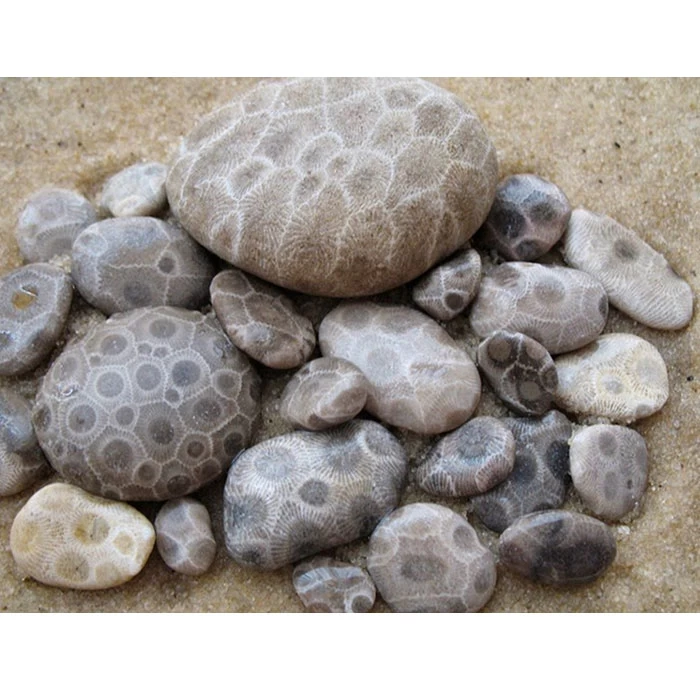
Fossilised coral is the preserved remains of ancient coral colonies formed at different times in Earth’s history. Petoskey stones (Hexagonaria) date back to the Devonian Period around 350–380 million years ago, while fossilised coral from other regions, such as Indonesia, is much younger.
Stones can be found in several locations worldwide. Some of the finest material comes from the shores of Lake Michigan and from Indonesia.
Fossilised coral refers to the fossilised remains of different coral species that lived millions of years ago. One of the most well-known examples is Hexagonaria percarinata, a species of extinct coral commonly found near Little Traverse Bay off Lake Michigan.
Widely used for decorative purposes, fossilised coral from the USA is known as Petoskey Stone. The stone and city of Petoskey, which lies on the southeast shore of Little Traverse Bay, are named after a 19th-century Indigenous American chief. 'Petoskey' is an anglicised version of his name which was Chief Pet-O-Sega or Petosegay.
How Fossilised Coral Formed
Fossilised coral formed when sections of the ancient coral were gradually replaced by natural minerals, most commonly calcite, and in some cases silica.
The corals had been growing in the oceans for almost five hundred million years. Many thrived in warm, shallow waters.
Over time, they became buried under sediments as the land surface moved and oceans rose and fell. Temperature and pressure from compaction caused deposits to slowly turn to stone, a process known as petrifaction.

Three hundred and fifty million years ago, the land that makes up Michigan was situated near the equator. At that point in the Devonian Period, a large shallow sea covered a significant part of the United States.
Much of Michigan was home to a large coral reef populated by various species of fish, trilobites and cephalopods. Although fossils of all these creatures have been found, the most famous are the corals themselves.
Fossilised coral formed from corals such as Hexagonaria, a mid-sized coral known for its distinctive honeycombed appearance. Individual coral creatures known as polyps secreted a limey substance that formed a corallite skeleton. When the skeletons combined, they formed large coral reefs composed of millions of individual creatures. Over time, parts of the reefs fossilised.
Corals have existed in Earth’s oceans for hundreds of millions of years, with different species appearing and disappearing over time. The fossilised coral found in Michigan, including Petoskey stone, formed much later during the Devonian Period, around 350–380 million years ago, when the region was close to the equator beneath a warm, shallow sea.
Article Pictures
The first picture in our article is courtesy of interwebsafari. The second is courtesy of Empirebluff.