Opal: Properties, Meaning, Facts and Photos
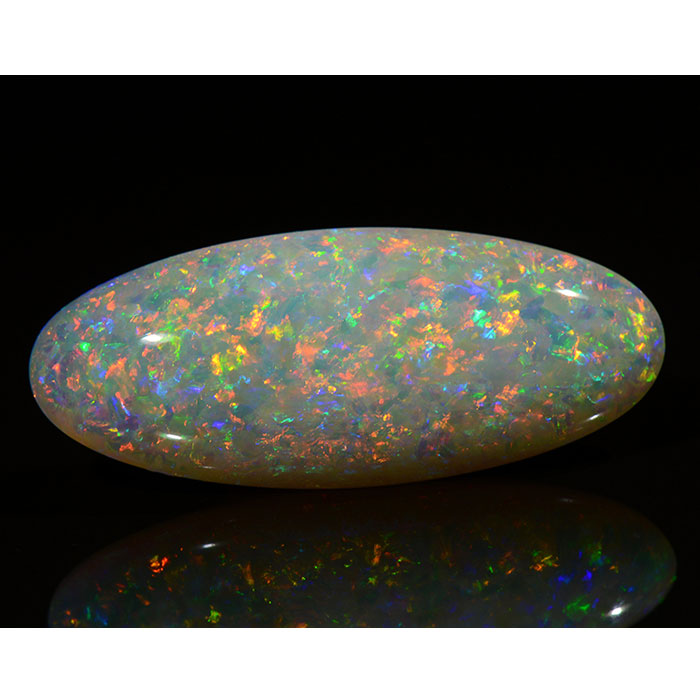
Opal is a naturally occurring material known for its unique play of colour. It's a form of non-crystalline silica with a high water content. This article explains what opals are, the different types, how and where they form, and where they're found.
| Contents 1. What is Opal? 2. What is Common Opal? 3. What is Boulder Opal? 4. Meaning of Opal 5. Are Opals Bad Luck? 6. Article Pictures 7. Shop Common Opal |
What is Opal?
Opal does not have a crystalline structure, so it's classed as a mineraloid. Varieties that display play of colour are known as precious opal.
Under the right geological conditions, as certain rocks, especially those rich in silica, like sandstone, break down through weathering, silica is released into groundwater trapped in cracks and voids in Earth's crust.
Over long periods of time, as the silica dissolves, the silica-rich water dries into a gel-like substance. Within the gel, microscopic silica spheres begin to form.
The spheres form in a closely packed, regular, repeating arrangement. The spaces between the spheres contain water, which helps maintain the opal's structure and stability.
As light passes through the opal, it's diffracted by the silica spheres which produce the characteristic play of colour.
Diffraction is the bending of light as it goes around an object. In opal, this only happens when the microscopic spheres are a similar shape and size and form a regular, repeating arrangement.
The quality of the play of colour and the colours that can be seen is dependent on the size of the spheres and the space between them. The more uniform the shape and size, the brighter and more intense the colour.
Larger spheres tend to produce red and orange colours, while smaller spheres produce blue and violet.
The most common colours seen in opal are red, orange, green and blue. Opal, also known as precious opal, does not have a crystalline structure, so is therefore classed as a mineraloid.
Precious opal is fragile and needs to be handled carefully. If exposed to heat, it can lose moisture and dry out, causing crazing, which is a network of fine cracks.
Around 95% of the world's opal comes from the outback deserts of Australia. The remaining 5% comes from Mexico, Brazil and the U.S. states of Idaho and Nevada.
More recently, opal has been found in Ethiopia and Mali.
Opals were discovered by Australian gold prospectors in 1863. They're believed however to have been mined much earlier by the Aztecs in South and Central America.
Some reports state opals from Ethiopia were being used as tools as early as 4000 BC, but factual evidence to support this is fairly vague.

What is Common Opal?
Common opal, also known as 'potch', has the same chemical composition as precious opal. The main difference is that it doesn't exhibit 'play of colour.' This is because the arrangement of the silica spheres is more random, so they don't diffract light.
Common opal can be translucent or opaque. The most common colour is pink, but it can also be found in white, grey, yellow, brown, green, blue, or orange. Black common opals also occur but are relatively rare.
Although most of the world's opals are 'common', they're not as well known as precious opal.
The name 'common opal' originated simply because it's relatively common and can be found in many countries around the world.
When used for gemstones, both precious and common opal tend to be polished as cabochons. Common opal is cut and polished this way because it's opaque. Precious opal is cut as a cabochon because the domed shape enhances the stone's play of colour.
Pink opal from Western Australia is pink mookaite. It's mined close to Mooka Creek, where the variety of Jasper called 'Mookaite' is found.

What is Boulder Opal?
Boulder opal forms in veins within ironstone boulders. This host rock is called ironstone.
The main constituents of these fine-grained, heavy, and compact sedimentary rocks are oxides of iron, clay and/or sand.
Freshly broken ironstone is usually grey. The brown external appearance more commonly seen is due to the oxidation of the stone's surface.
Ironstone can also be found in a red and black banded form. When polished as a gemstone, this material is also known as tiger iron.


The Meaning of Opal
The meaning of 'opal' may have come from the Sanskrit word 'upala' meaning 'valuable stone'. Upala is likely to have come from the Greek 'opallios', which loosely means 'a gem with a kind of play of colour.'
Legends and myths have been associated with rocks and minerals for thousands of years. A story once told by Australian aborigines claims God came down to earth on a rainbow to bring the message of peace to all mankind. At the spot where his foot touched the ground, the opal came alive and sparkled with the colours of the rainbow.
The ancient Greeks believed opal could give the wearer the power of foresight. The Romans revered it as a symbol of hope and purity and believed it could offer protection from disease.
Eastern cultures regarded opal as a symbol of truth, while ancient Arabs believed it came from heaven. They also believed it acquired the play of colour from flashes of lightning.
During the Middle Ages, opal was thought to be beneficial for eyesight. Some claimed it could render the wearer invisible. For this reason, it was often carried by thieves.
The French Emperor Napoleon gave his wife Josephine a magnificent opal called 'The Burning of Troy.' The name came from the stone's variation of colour.

Are Opals Bad Luck?
Opals have long had a reputation for being bad luck. This superstition arose primarily because of a book written by Scottish historian, novelist, poet, and playwright Sir Walter Scott. Published in 1829, 'Anne of Geierstein' describes opal as an unlucky stone.
However, its reputation was gradually restored by public figures, including Queen Victoria and French actress Sarah Bernhardt, who wore and promoted opals.
Some also think opal is unlucky because it can crack or become damaged very easily. When replaced, if not looked after carefully, subsequent stones may also crack, contributing to the perception that opal is unlucky.
The most common reason for opal cracking is dehydration.
Article Pictures
The opal in the photo at the top of our article and the opal in the petrified wood: Courtesy of Stan Celestian. The second opal and the common opal: Courtesy of James St. John.
Pop-up photos
Sandstone and precious opal in ironstone boulder: Courtesy of James St. John. The pink opal is part of our collection. Boulder Opal: Courtesy of Stan Celestian.
The photos in our article and the links for the pop-up photos link to the original image on Flickr. You may only be able to view them if you join. Joining Flickr is free, with no additional charges.