Moldavite: Properties, Facts and Photos
What is Moldavite?
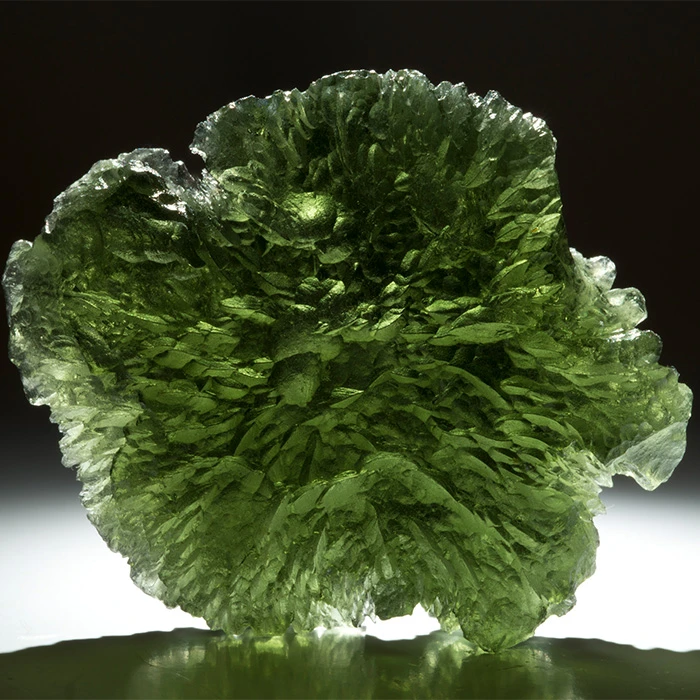
Moldavite is a natural glass formed following a meteorite impact in the Moldau Valley (now the Czech Republic). The event is believed to have taken place approximately 14.8 million years ago.
Sometimes incorrectly spelt moldovite, this translucent dark green substance is relatively rare.
Moldavite is part of the family of 'glassy objects' known as tektites. These include irregular and sometimes intricately shaped nodules or 'blobs' of a glassy substance that often contains tiny bubbles.
The name tektite comes from the Greek word 'tektos', meaning 'molten'.
Moldavite has no internal crystalline structure, so it's not a mineral. Naturally occurring solids that are not crystalline are correctly known as mineraloids.
The chemistry of tektites is unique. Samples taken from rocks at the impact site where moldavite formed confirm that it was created following an impact from a meteorite.
The impact and immense heat melted rocks and ejected them high up into the atmosphere. As they cooled and fell back to Earth, the liquidised stone formed glass-like bodies.
Many different types of tektite formed during similar impact events. Most have their own names, but moldavite is by far the best-known.
The pitting on the surface of the rough material comes from it being submerged in water for a long period of time.
Moldavite was originally believed to come from the moon. Some believed it may have been a by-product of a volcano. Others suggested it could have been produced following the explosion of an Earth-like planet in the asteroid belt.
Following analysis of samples from the moon in 1969, scientists confirmed moldavite was definitely of terrestrial origin.

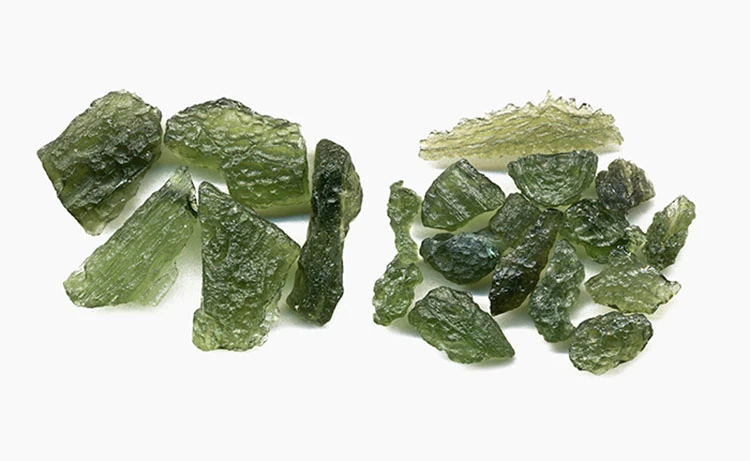
Moldavite is known to have been used to make tools during the Stone Age. Thousands of years later, it was a popular talisman.
Some believe it was originally an emerald that fell from the sky from the crown of an angel. Exposure to anything that's been in contact with moldavite is said to quicken one's spiritual evolution.
Moldavite grades 5 to 5.5 on the Mohs scale of hardness.
Beware of Fake Moldavite
Moldavite is rare and expensive, so fake material is being produced on an industrial scale.
If you're looking to buy moldavite, only buy from a reputable and trustworthy seller. If you take a chance, you may end up with an expensive piece of glass.
It's worth noting that only one moldavite mine in the Czech Republic is currently in use, and the amount being excavated has been drastically reduced in recent years.
Due to the negative impact of mining practices on the environment, no other source has been approved by the government. That said, plenty of moldavite is being mined illegally for sale on the black market.
Fake moldavite from China can look incredibly authentic. A considerable amount is reaching Europe and North America through Hong Kong and India.
I have been led to believe that some retailers are selling a mixture of real moldavite and fake.
There are many articles online that advise on how to identify genuine moldavite. However, not all of the advice is trustworthy or correct.
Rough moldavite has a unique appearance and texture. Some fake material is easy to identify, but other stones, especially those that have been polished, can be far more convincing.
When cut and polished, moldavite looks very similar to dark green glass. One thing to look for in genuine cut stones is Lechatelierite. Lechatelierite is a kind of pure quartz glass.
It's created when quartz mineral grains melt due to intense heat, which is what happened during the event that led to the formation of moldavite.
Lechatelierite looks like fine, squiggly, elongated, and sometimes twisted strands. It's not possible to see them without a loupe or other magnification.
Article Pictures
The moldavite at the top of our article is courtesy of Stan Celestian.
The second picture is courtesy of James St. John.
The piece in the third photo was once part of our collection.
Pop-up photo
Meteorite: Courtesy of Stan Celestian.