Howlite vs Magnesite Explained
What is Howlite?
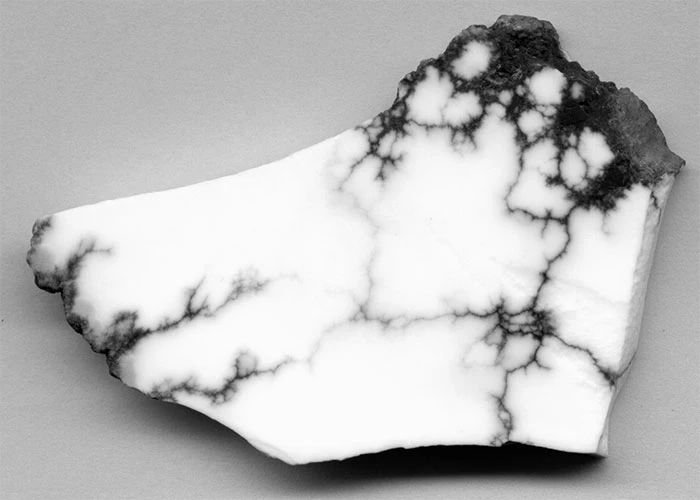
Howlite is a naturally occurring borate mineral that usually forms as rounded or irregular nodules. Some nodules resemble small cauliflowers, while others form compact masses that can be cut and polished.
It was first described in 1868 after material was found at a gypsum quarry near Windsor in Nova Scotia, Canada. The mineral was studied by Henry How, a chemist, geologist and professor at King's College in Windsor.
How originally named the new mineral silicoborocalcite. American mineralogist James Dwight Dana renamed it howlite shortly afterwards in recognition of Henry How.
Dana was one of the most influential American mineralogists of the nineteenth century and author of the Manual of Mineralogy.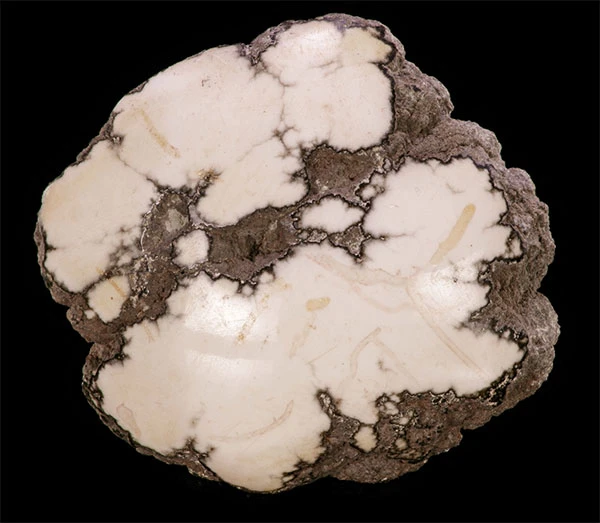
The original locality is now known as Black's Quarry. Howlite has since been discovered at other locations, including parts of California, Mexico, Serbia and Turkey.
Two of the best-known American occurrences are the Tick Canyon borate deposit and the Kramer borate deposit in California. At Kramer, Mindat describes howlite occurring as sparse, cauliflower-like nodules associated with borate deposits.

For many years, California supplied much of the howlite used for lapidary work. Because the material is white, relatively easy to work with and capable of absorbing dye, it also became one of the best-known minerals used to imitate turquoise.
The stone in this image was described as howlite, but from a photo alone, it's not possible to confirm that. The orange marking could possibly strengthen the claim, but only if it's a borate impurity.
Since magnesite can also show brown impurities, the only way of knowing for certain would be through appropriate testing.
Is Your Stone Really Howlite?
Howlite is a stone that many people who buy crystals, rocks and minerals say they would recognise. On most commercial websites, it's usually pictured as a pure white stone with distinctive grey veins.
It's widely used for tumbled stones, carvings, beads and gemstones. The problem is that much of the material sold as howlite isn't howlite at all. It's magnesite.

Howlite and magnesite are two completely different minerals. Although some material can look very similar, especially once cut and polished, they have different chemical compositions and form under different geological conditions.
Finding photos of genuine howlite online is surprisingly difficult. Search results are dominated by listings of material labelled as howlite, even though most of it is magnesite.

Specialist mineral databases such as Mindat are among the few reliable places to see photographs of genuine howlite.
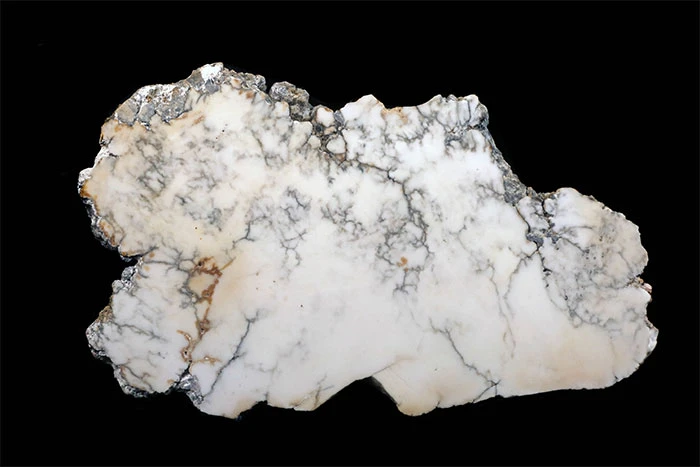
Howlite doesn't always resemble the familiar white stone with grey spidery markings.
In some deposits where howlite is found, it can be very common, but it's not generally classified as a common mineral. Although well-formed howlite crystals have been found, they are very rare.
Howlite and Magnesite: Two Different Minerals
Howlite is a calcium borosilicate hydroxide. Magnesite is magnesium carbonate. Chemically, they're completely different minerals.
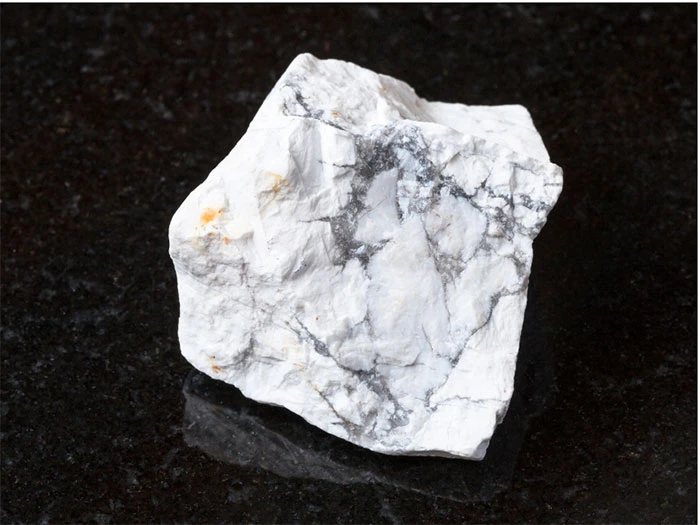
Magnesite occurs in several forms, but the material used for carvings, beads and tumbled stones is usually white with grey, spidery veins. This is also the material used to produce fake turquoise.
Geology.com states magnesite can be difficult to identify and is often confused with howlite.
The confusion is now so widespread that few buyers are even aware the material they're buying is probably magnesite. One U.S. mining company, which operates its own mine and also sells a wide range of rocks and minerals, states on its website that howlite is also known as magnesite, which is geologically incorrect.
Howlite from the Tick Canyon deposit in California has been described as having very dark or black veining. In magnesite from South Africa, the veins are often a much lighter grey. Howlite can also have markings that are a lighter grey. When cut and polished, the two stones can look very similar.
The person who bought the piece in this photo was told it was howlite. It's magnesite.
Why So Much 'Howlite' is Actually Magnesite
A 2026 article published on Mindat discusses this problem in detail. It explains that much of the material historically used as howlite came from the Tick Canyon borate deposit. As the source declined, magnesite became a cheaper and more readily available alternative.
Its similarity to howlite in a massive formation, plus the fact that it's relatively soft, made it easy to cut and polish. Both howlite and magnesite absorb dyes well, making them suitable for producing fake turquoise.
In an article from 1993 written by the Gemological Institute of America (GIA), the authors reported dyed magnesite being used to produce "howlite lapis." Howlite lapis is a trade name for a stone dyed to resemble lapis lazuli. The material and the name are still used today.
Magnesite is widely used in industry, and large deposits exist around the world.
How to Tell Howlite from Magnesite
Although the two can look very similar, there are several differences between howlite and magnesite.
One is density. Howlite has a specific gravity of about 2.62. Magnesite is considerably denser, with a specific gravity of about 3.0.
We explain how to carry out a specific gravity test in another article in our blog. We also share the results from testing a stone we believed was howlite.
Hardness is another useful test, although it's not as straightforward. Massive howlite, the type used for carvings and polished stones, can have a hardness of around 3.5. Magnesite generally grades between 3.5 and 4.5, so their hardness can overlap. A scratch test may therefore not provide a definitive answer.
Magnesite is a carbonate mineral and can fizz in hydrochloric acid, especially if powdered or warmed. Howlite does not fizz in the same way. This is not a test to carry out at home.
Colour and veining can offer clues, but they are not reliable enough to make a conclusive decision. Howlite has been described as having darker, often black veining, while some magnesite can have lighter or more subtle grey veins. The problem is that there are too many variations in both stones for the stone's markings to be used as a reliable test.
The problem is now so widespread that magnesite has effectively become accepted as howlite throughout much of the crystal trade. Unless the stone has been tested or its source is known, it's impossible to say with certainty that a stone sold as howlite is actually howlite.
Article photos
Howlite (1st photo): Courtesy of James St. John. Howlite (2nd photo): Courtesy of Rob Lavinsky. Magnesite (third photo): Courtesy of Yash Redkar. Howlite (fourth photo): Courtesy of Ron Wolf
Pop-up photos
Howlite tumbled stones (more likely to be magnesite): Stone Mania. Howlite: Courtesy of Rob Lavinsky (irocks.com). Howlite: Courtesy of Knut Eldjarn.
The photos in our article and the links for the pop-up photos link to the original image on Flickr. You may only be able to view them if you join. Joining Flickr is free, with no additional charges.